
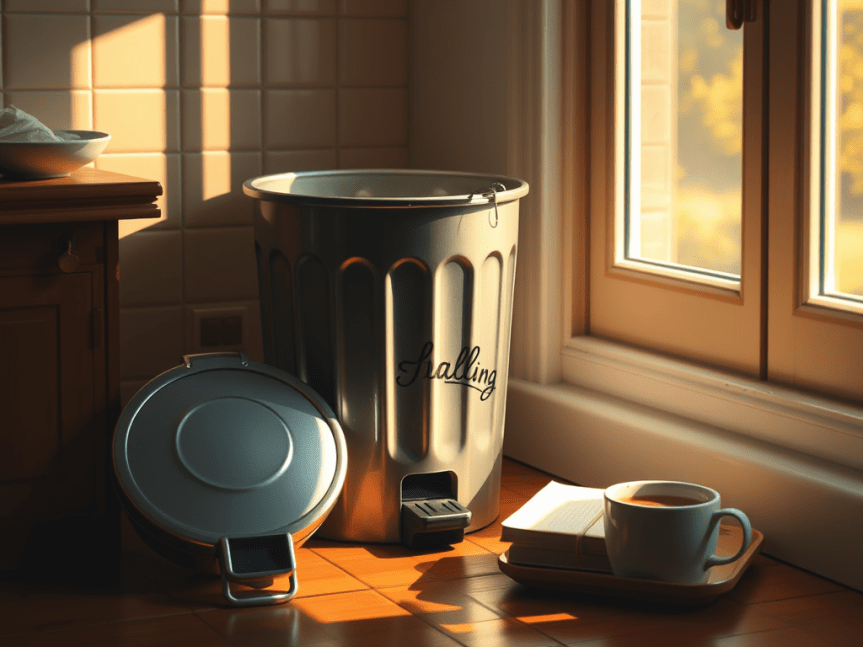
I broke my kitchen garbage can the other day. The can – this one – has a pedal that one must depress with their foot to open the lid. Below the pedal is a stabilizing metal bar that keeps the can from toppling forward when in use. The stabilizing bar is what broke…again.
This is supposed to be the trash can that can survive an apocalypse. The first time it broke was late last year and we chalked this up to a faulty mechanism or bad design. “Is nothing made as it used to be?” we wondered once again, lamenting for those good old days that were neither good nor long enough ago. We both turned into MacGyver, turning the can over, and assessing the situation. A strong adhesive to glue in the corners of the stabilizing metal bar and plastic fittings was completed. Crisis averted? Or, just delayed?
Last week, while depressing the foot petal to raise the lid, I heard that telltale sound of a crack to the stabilizing bar. Recognizing the sound, I stopped to check my own behavior, or to check in with myself. (This is new – paying attention. My ADHD internalized so much!) I’ve become more aware of my own participation in life and “things”, and my tendency to shove everything into an external blame situation. My mind began with “what a piece of crap” and stopped mid-thought with a new idea. Instead of blaming the poor kitchen receptacle that just sits in judgment of me, was there something I did that contributed to it breaking? Did I press too hard with my foot? (Enter sense of shame.) Just how sensitive is this thing anyway? (See, the habit is a hard one to break!)
That was when I recognized the issue I needed to handle was not about the trash can at all. In fact, it is the same issue with a new and exciting flavor: mindfulness with a dash of presence. Or, how can I get more out of my head. I’m being guided and shown this idea in a variety of situations. (Yes, guided. More on that topic to come.) Situations that are a lot more serious than a broken piece of a garbage can.
I learned that, in caring for my dying mother, the responsibility was so tremendous, and I felt honored and humbled by the turn of events. My sister and I took extra care of her, cleaning her, reading to her, talking to her, and ensuring her comfort… just like when she did for us as babies. We kissed her, loved on her, and tried to be the best daughters to the best mother in the world. This required my full attention and presence. When I was distracted, I effortlessly pulled my focus back to my mother. This was a life and death situation and needed me totally aware so the correct decisions were made. Since then, my husband and I also cared for our dying and much beloved dog, Toby, which was also an honor of a different kind – yet, it taps the same feelings of love and protection but with differing angles. In caring for Toby, I found myself becoming angry at “having to do” and did not like the feeling at all! I didn’t understand these emotions as they felt disingenuous and conflicted with my heart. These new emotions did not honor nor represent my feelings for my beloved miracle pet and felt just wrong. So, instead of squelching this into some new package, I felt the emotions. These were sadness, loss, grief, and a sense of loneliness – and the same emotions I felt in processing these losses. What was I to learn by these events?
What changed in both of these situations was me: my mindset of gratitude and acceptance of both the situation and myself. I allowed myself to feel these emotions in a more healthier way. I cried, hugged, cooked, cleaned – all the physical things to make my body as tired as my mind felt. Sleep and distraction were also my friends along with a dose of “pulling myself up by my bootstraps.” Such a difficult yet educational time in my life that I’m glad I learned something from these situations!
Now, back to the can. I accepted that I heard a crack and that I had once again broken the can. Stopping mid-stride away from the can, I began to assess just what happened. Being in the present moment – or being mindful of this moment – was key for me. The crack of the can brought me out of a state of unawareness and into a present sense of reality. The ideas of being mindful and being present are issues I have been working on in myself for a while now through a program of meditation. You see, my particular brand of ADHD is dreamy and very internal. I can drift off in my mind to some other place and am not be fully present during a conversation. Usually something said will trigger something in my brain and I get transported to another place. Trauma meets ADHD – or life floating on a cloud. Sounds nice, right? Not really. In serious conversations, I would frequently lose the thread of the conversation. I used to try and engage the speaker so I could grasp this weakening conversation thread only to interrupt the speaker and distract them in the same way that I was also distracted. Then, because I was very good at recovery (practice makes perfect), I could interject a few words here, sound amazing, and the speaker would just be left confused.
This is a key aspect of my brand of ADHD and my neurodivergent brain –or my personal superpower. It is a learned response and not necessarily a good one. I can mentally travel years in a single second! Forward or – sometimes in reverse. Yet, my memory is for shit. During these times – it’s not always – I would be yelling at myself for this habit, chastising myself for being selfish or standoffish, and not even having a correct recollection due to my own distraction! (Imagine living in THAT place?) “Why can’t I pay attention?” I’d lament to myself. “How…” insert label here “…stupid/dumb/ugly/fat/awful/mean…..are you? You name it, I’ve called myself this name. Many times over. Thinking this was abnormal and that I was broken. Yes, maybe this isn’t normal but it is MY normal – and I have a legitimate physical reason for the behavior. I’m not stupid/dumb/ugly/fat/awful/mean for this.
Today, I am in a place of acceptance. I’m not selfish or standoffish – as my mother used to say to me. I’m DISTRACTED by my own thoughts that are now layering in yours and getting all jumbled up and confused. Sometimes I need to stop and re-frame my thinking – and ask for time needed to ‘catch up’ or for someone to repeat themselves. This can be very difficult for the person speaking and has caused troubling interactions and unintended offense. Today, I’ve learned that this tendency originates from a neurodivergent brain. This diagnosis gave me the ability to accept ADHD as part of me, an explanation for certain behaviors. This is not my entire identity but gave me greater awareness and, thus, the ability to create positive behavior strategies.
Or, I stopped trying to ‘fix’ myself. I am accepting my mental dreaming as part of my own personal human uniqueness. This is why the ADHD diagnosis is so important. It explained so much and gave me the ability to accept what is and without the condemnation of self. This wasn’t a behavior problem to be solved. My issues were my natural coping mechanism and my ability to focus and be present.
I began to see the trash can more as a mirror for me to recognize that I was doing something wrong. No, wrong isn’t quite correct. That is my old self talking. Today, I’m doing something out of congruence with my feelings. Self-acceptance is very powerful and a key tool for me. What am I being told by the breaking of the stabilization bar? Well, obviously I’m using too much pressure on the can with my foot.
So, instead of complaining about the can or being angry at something breaking, I became curious. Why is the pressure I’m using breaking this can feature? Is it my superhuman foot strength that has never been in evidence before? Should I take my newfound strength to the NFL as a field goal kicker? I must be really strong, no?
No.
A fun and meandering argument with myself takes me out of the shame loop and gave me space between thoughts. This was when I realized I was needing be be more mindful and see the situation in the moment. Here is what happened: Instead of stopping and opening the lid with my foot, I walked towards the can mid-stride to open the lid while simultaneously walking away from the can. Economical, aren’t I? I “walked” by the can to open the lid while on my way somewhere else. This caused too much pressure to be used. Or, I was too busy just to stop and use the garbage can. Isn’t that something of a realization? Too busy to focus on pressing a pedal with the correct amount of pressure.
Trust me, I never, ever want to be that busy. The idea of slowing down, paying attention to the pressing of the foot pedal, raising the can lid within a state of mindfulness was appealing to me. I wasn’t sure why and I had to think on this point. Why does the idea of slowing down appeal to me? The idea reminded me of Aki and his content created on YouTube in his Samurai Matcha channel. He has a video linked here that I have watched a few times on cleaning. These are not “how to” videos but “why” and, importantly, how one engages their mind in the physical act of cleaning. I had not done this in my kitchen cleaning duties. Aki has had quite a few physical challenges of late where mindset has been key. His ideas of cleaning translated to mindfulness in very serious health situations, too. Just how powerful is this idea?
Once again, back to the can. I realized that I was not being present or mindful in my cleaning activities as Samurai Matcha recommends. Apparently, I automatically labeled my situation in my head as a chore or being mundane or unimportant. These ideas are what caused me to gloss over the moment and seeking the important things outside of my current activity – or increased my distraction. If I see the moment as unimportant, I am missing the joy of the activity. How can I see all moments as important? Well, one must first have the realization that they have not applied the most helpful mindset for this particular moment. I had not even realized that I had even labeled the idea of pushing the foot pedal as anything other than a chore on my way to something else. This slight cracking noise of the breaking connection totally took me out of the mental reverie I didn’t even know I was in because I was physically busy. Interesting idea.
One thing I’ve learned is that there is a lesson in most everything in life. So, I’ve stopped trying to actively change myself and am trying to become more of an observer. This is a struggle that I’m finding a constant yet rewarding battle with my ego. I’m doing OK. I do have certain behaviors that do not please me for any reason other than wanting to be happier. Mindfulness – or presence – in even the mundane can be a struggle. Sometimes, life throws an experience for you to learn the simplest of ideas – like a broken trash can. Being mindful feels like slowing down. Yet, is mindfulness truly slower? Or, our natural state. I like to think they are both the same thing.
Peace.
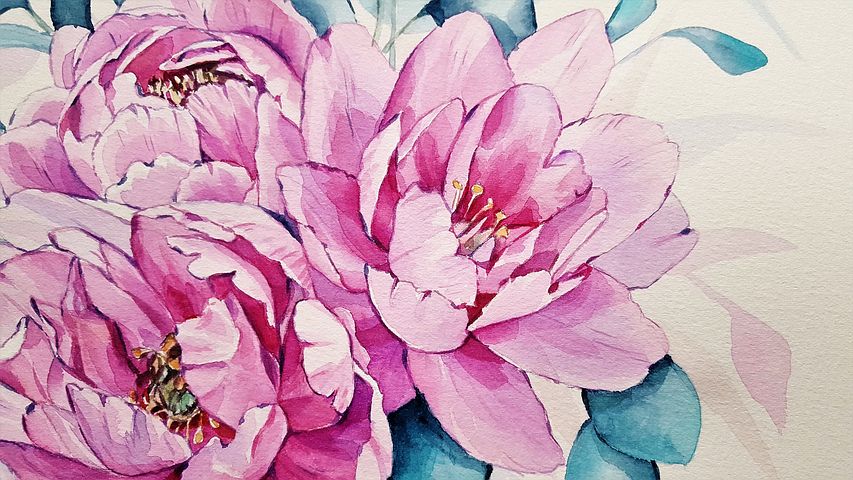
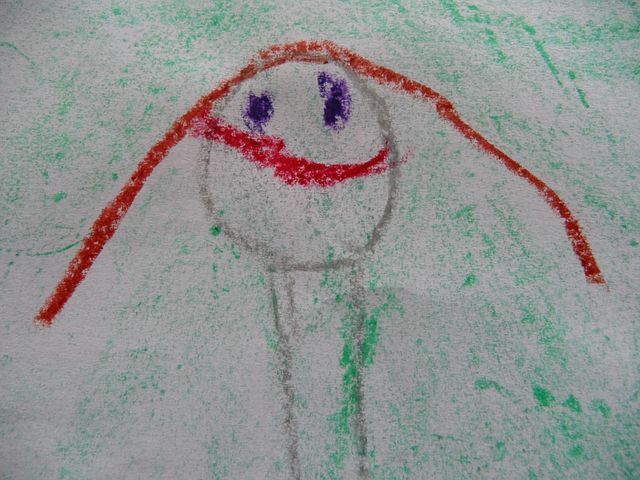 mind. You see, my hands just don’t seem to “see” my creations in the same way as my brain because my hands really don’t execute the vision all too well. My hands are very solid and have served my utilitarian needs quite well, of which I’m extremely thankful. They have not, however, been able to interpret just what my mind’s eye sees to be able to create the masterpieces I dream of. It all ends up in a mess on whatever I’m painting/drawing/sculpting…you name it. (It seems to all end up being ashtrays.) My hands just don’t really keep up with my mind’s eye of what I see.
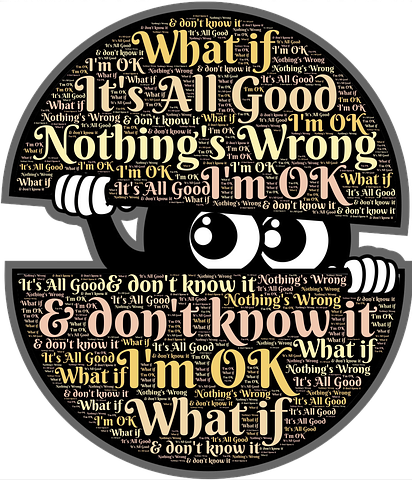 I just did not have these feelings for my own art as I was way too self-judgmental, a handy trait to have in business but not necessarily for a creative person. I think my mindset was more of a “Why let other’s beat you up when you are doing such a fine job of the task?” This is what art does – it creates an introspection of feeling and expression. Those feelings are what the art evokes and is why we all appreciate art because it makes us all feel….something.
 At the same time, I was trying to handle a failing personal relationship. In a deeply personal moment, I read my poetry to my father’s body giving him a piece of me to take with him on his new journey, and I included my poetry in his casket for cremation, like a piece of my heart is always with him. And, THAT, is what art is: A piece of one’s heart.
 The Wobble